
How Behaf is Building Conversational Commerce for Indian D2C Brands

A few years ago, we started building WhatsApp automation for businesses.
At first, the work was very different from what Behaf is becoming today.
We worked with businesses across real estate, retail, events and D2C. Every business had its own workflows, products and problems. But after a while, I started noticing something that kept repeating itself.
Brands were getting really good at getting attention.
They were running Instagram campaigns. Working with creators. Posting reels. Building communities. Getting people interested in their products.
Then the customer would send a simple message like..
“Is this available?”
“How much is it?”
“How do I order?”
“Can you deliver to Kochi?”
And suddenly, everything starts being manual – answering queries, sending payment links, confirming orders, arranging shipping, and doing follow-ups.
The bigger the brand became, the more difficult this got.
That was the moment we started questioning what we were actually building.
Were we just automating conversations, or was there a bigger problem underneath them?
The more we looked at it, the clearer it became.
The problem wasn’t WhatsApp.
The problem was that the internet had separated shopping into too many different places.
- A customer discovers a product on Instagram.
- They click a link. They open a website. They search for the product. They compare options.
- They add it to a cart. They enter their details. They pay.
- Then they go back to WhatsApp to ask where the order is.
We kept thinking: why does it have to be this complicated?
“What if the conversation was the store?”
What if instead of asking a customer to understand a website, the technology could understand the customer?
That became the idea behind Behaf.
We started building Behaf as a commerce platform for Indian D2C brands, with one simple belief: a brand should be able to sell where its customers already are.
WhatsApp is already a huge part of how Indians communicate. People don’t just use it to talk to friends anymore. They use it to ask businesses questions, share products, get recommendations, send payment information and track things they have bought.
So we decided to build around that behaviour instead of trying to change it.
With Behaf, a D2C brand can create a free chat store and share it with customers. The customer can discover products and have a conversation with the brand through WhatsApp.
But the interesting part isn’t simply putting a catalogue inside WhatsApp.
It is what happens when AI becomes part of that conversation.
Imagine someone saying:
“My wife’s birthday is coming up. She likes jewellery. My budget is ₹5,000. What should I buy?”
A normal ecommerce website would probably show a search bar.
A conversational store can ask a question.
“What kind of jewellery does she usually wear?” “Gold or silver?”
“Something for everyday use or a special occasion?”
The customer doesn’t have to know the exact product they are looking for. They just have to explain what they need.
That is what we mean when we talk about conversational commerce.
People don’t naturally think in filters.
They think in context.
“Mummy ke birthday ke liye ek achhi silk saree chahiye, 5 hazaar ke andar.”
That sentence contains occasion, relationship, product category, material and budget without the customer ever filling out a form.
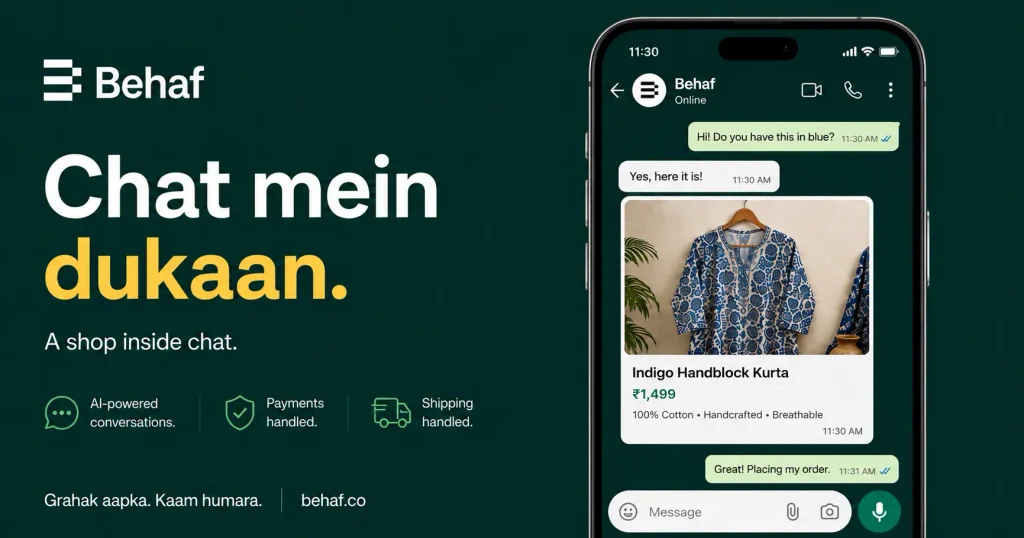
We think AI can turn that kind of natural conversation into a much better shopping experience.
But there was another part of the problem we didn’t want to ignore.
Selling isn’t only about finding a product.
There is everything that happens after the customer says yes.
Payment. Order confirmation. Shipping. Tracking. Customer questions.
For a small D2C brand, managing all of this across different tools can become a job in itself.
So our goal with Behaf is not to give brands another piece of software to manage.
We want to take care of the work behind the sale.
The brand does the marketing. Behaf does the selling.
Payments and shipping are integrated into the same commerce journey, while the brand remains at the centre of the customer relationship.
Our line for this is simple:
“Grahak aapka. Kaam humara.”
The customer is yours. The work is ours.
We are still early.
That is something I don’t want to hide.
We are preparing Behaf for launch and starting with a limited group of founding D2C brands. We are using this stage to learn what actually works, where customers get stuck, what sellers need and how much of the selling journey we can genuinely simplify.
There are still plenty of things we need to figure out.
But the direction feels right.
We started by building WhatsApp automation.
Then we realised that the conversation wasn’t just a place where commerce happened.
It could become the interface for commerce itself.
“The first generation of ecommerce taught us to search. The second taught us to browse. Maybe the next one will teach us to simply ask.”
That is what we’re building towards with Behaf.
Not another marketplace people have to download.
Not another website people have to learn.
A simpler way to shop and sell, inside a conversation people already understand.
We are building Behaf for the D2C founders who are great at making products and building brands, but don’t want to spend their time stitching together technology just to sell them.
And we’re building it for the customer who doesn’t always know what product they want, but knows what they need.
Sometimes, the best shopping experience may not be a better search bar.
It may just be a better conversation.
Jerish Jacob, Co-Founder, Behaf