
GHO: From Research to Patient Decisions Based on Data
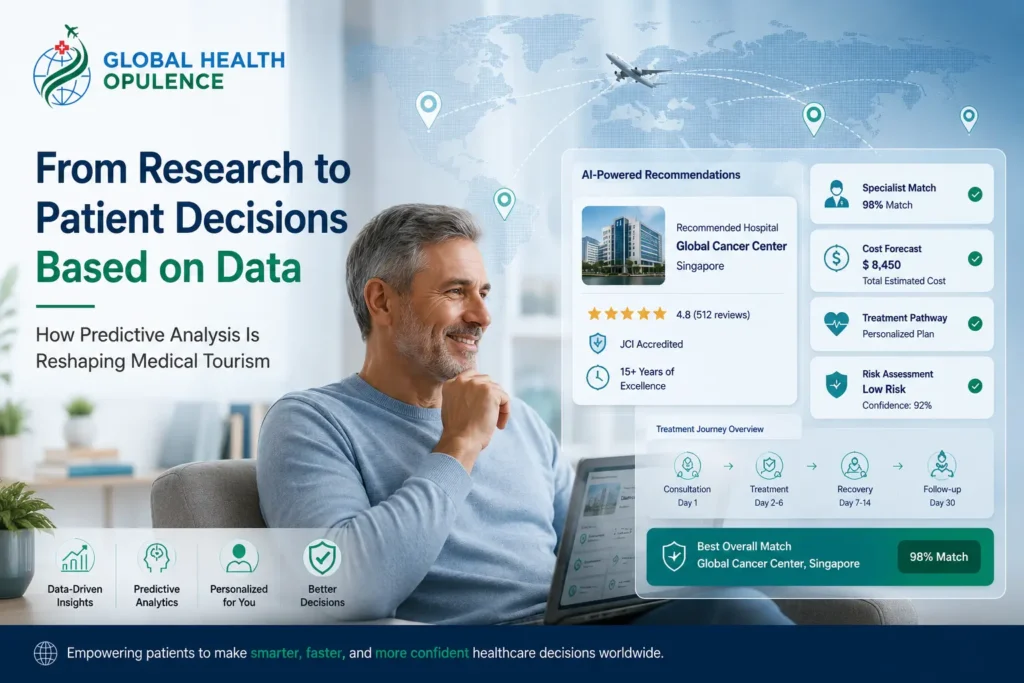
Medical tourism is a global industry that links millions of patients to healthcare opportunities beyond their home countries. But even with more access than ever to hospitals, specialists and treatment options, one challenge remains a constant in the patient experience: decision making. With the rise of healthcare options, predictive analysis is emerging as a powerful tool to convert medical tourism from a reactive research process to a more personalized, data-driven journey.
The paradox of information in the medical tourism marketplace
The modern medical traveler has more information at his or her fingertips than ever before. By the time a patient is considering going abroad for treatment, he or she can compare locations, check out hospital credentials, evaluate specialists, research procedures, all in minutes.
But more information has not necessarily made decisions any easier.
For example, a patient looking for cancer treatment may look at hospitals in Singapore, India, Germany and Turkey. Another researching orthopedic surgery may evaluate providers across multiple continents before narrowing their choices. In both cases, patients often have to contend with fragmented sources of information, inconsistent pricing models, different accreditation standards and conflicting recommendations.
The industry has been successful at increasing access to health care choices. It has done a less good job of helping patients figure out which option is right for them.
For those tracking the evolution of international healthcare travel, the rise of medical tourism is part of a wider trend towards patient-driven healthcare decisions, with people more willing to cross borders to access better value, specialist skills and greater access to care.
Why Studies on Traditional Medical Tourism Are Becoming Outdated
The traditional medical tourism model is heavily dependent on self-directed research. Patients bounce from hospital websites, physician profiles, health care forums, accreditation databases, patient reviews, and travel resources, trying to piece together a complete picture of their options.
It’s a difficult and time-consuming process.
Importantly, it shifts the burden of analysis to the patient. Patients facing hard medical decisions are assumed to evaluate clinical quality, compare treatment alternatives, have knowledge of recovery requirements and costs across systems of care.
This worked when the industry was smaller and the range of destinations limited. However, today patients face a much more complex landscape.
The problem is not finding healthcare options anymore. The trick is to filter them properly.
The Transition from Information Gathering to Decision Intelligence
According to Gartner, organizations are increasingly adopting Decision Intelligence to improve decision-making, while McKinsey reports that 65% of organizations now regularly use generative AI, highlighting a broader move from information gathering to actionable intelligence.
Decision intelligence is a concept that’s increasingly being talked about across the healthcare and technology industries and is helping define the next wave of medical tourism.
Decision intelligence is not just about providing information; it’s about helping people to make better decisions. Whether it is Medical Tourism in Indonesia or anywhere else in the world, AI is reshaping the patient journey.
For medical tourism, this translates to shifting from hospital directories and destination listings to data interpretation systems that deliver tailored recommendations.
Here’s what distinguishes traditional healthcare travel research from emerging predictive models:
| Traditional Medical Tourism | Health Journey Prediction |
| Patients manually search through dozens of hospitals | Systems figure out the most relevant options |
| Cost estimates are often broken | Forecast of total treatment journey costs |
| Research is very review and marketing driven | Healthcare intelligence supports decisions |
| Extensive analysis is needed on selecting providers | Tailored recommendations for the patient |
| Risks are identified in the process | Potential problems are visible earlier |
| Planning is mostly reactive | Planning is data-driven and proactive |
This shift could fundamentally change how patients approach treatment abroad.
How Predictive Analytics is Changing Healthcare Travel?
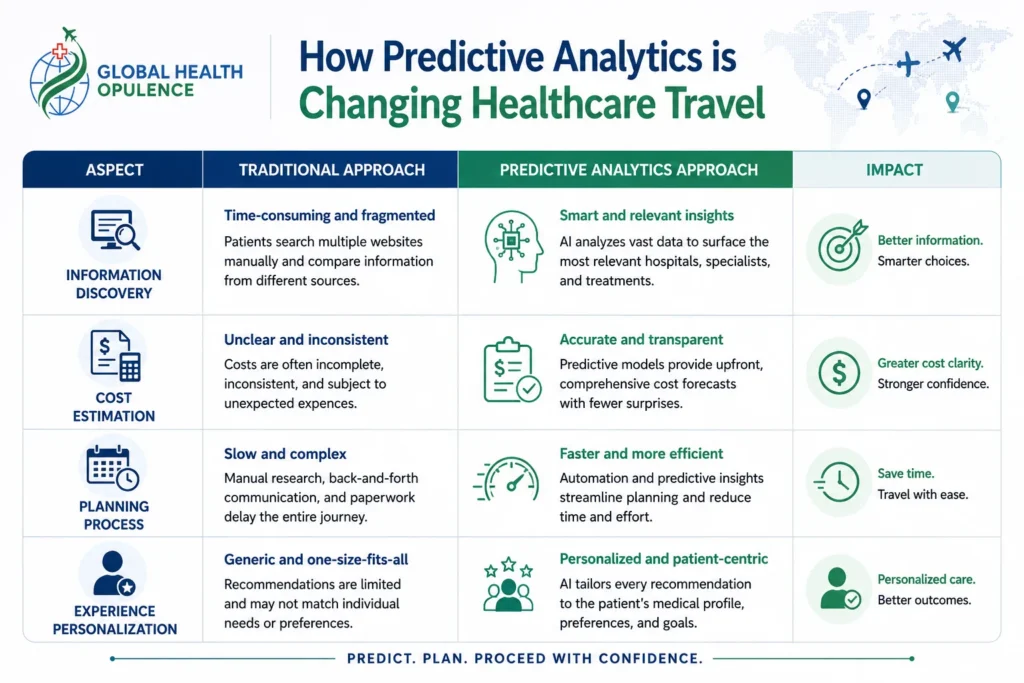
According to the latest reports from Gartner, organizations are increasingly shifting toward Decision Intelligence frameworks that combine data, analytics, and AI to improve decision outcomes rather than simply increase access to information.
Predictive analysis uses data, patterns from the past, patient profiles, and healthcare knowledge to predict likely outcomes and inform decisions.
Healthcare systems around the world already use predictive models to identify patient risks, improve resource allocation and optimize care delivery. Medical tourism is beginning to embrace the same principles.
Rather than having patients sift through hundreds of potential choices, predictive systems can help narrow recommendations based on individual circumstances.
For most patients considering treatment abroad, medical need is rarely the only consideration. Ultimately, the final decision is influenced by financial situation, travel preferences, recovery times, family support requirements, and the accessibility of the destination.
Predictive analysis can help pull these factors into a single decision framework.
New healthcare travel platforms are increasingly focused on finding the treatment pathway most likely to deliver the desired outcome, rather than asking patients to choose which hospital looks best on paper.
Why Cost Forecasting Is More Useful Than Cost Comparison
Cost continues to be one of the most powerful drivers of medical tourism. However, many patients still evaluate treatment abroad only on the basis of procedure prices.
This can lead to misleading comparisons.
The true cost of a healthcare journey is more than the operating room. All the accommodation, diagnostics, medications, transportation, rehabilitation services and follow-up care can add up to a very big financial commitment.
A procedure that may seem cheaper at first could be more expensive when considering the entire treatment pathway.
Predictive analytics provides a more holistic approach. If we analyze patients’ journeys in the past and the common variables in treatment, we can predict the likely expenses before the travel starts.
This offers patients greater clarity and reduces the ambiguity that can often go hand-in-hand with making decisions about international healthcare.
As health-care consumers become more sophisticated, the ability to forecast costs will likely be as important as the ability to compare costs.
For patients considering treatment overseas, the complete financial picture is often more useful than just comparing the cost of the procedures in isolation.
Personalized Healthcare Travel is Booming
Personalization has revolutionized industries from finance to retail, hospitality and entertainment. The travel health industry is on a similar journey.
Patients with the same diagnosis do not have the same needs often.
Two individuals desiring the same procedure may be miles apart in age, health status, travel tolerance, recovery expectations and financial priorities. What is ideal for one patient can be totally wrong for another.
And that’s why the future of medical tourism will be less about generic destination suggestions and more about tailored treatment pathways.
The best healthcare travel experiences will be those that take into account the entire context of a patient’s decision.
This covers not just the clinical requirements but also the logistical, financial and personal ones.
Information about choosing a hospital abroad often focuses on accreditation, quality of treatment, and the expertise of the physicians. Predictive analytics goes a step further with this framework, giving patients a sense of how these factors come into play in their own situations.
Intelligent Guidance Will Be the Future of Medical Tourism
The medical tourism industry is entering a new level of maturity.
The key difference is not longer about access to hospitals and specialists. Information is not enough anymore. Patients are increasingly demanding clarity, transparency and guidance along the decision making process.
One way to get there is through predictive analysis.
Transforming disparate data into meaningful insights can help make healthcare travel more effective, more personalized, and, ultimately, more patient-centered. Rather than spending months navigating disconnected sources, patients can focus on understanding the options that are most relevant to their needs.
The future of medical tourism will not be about the lowest price points or the largest hospital networks. It will be part of health care ecosystems that can reduce complexity and help patients make informed decisions with confidence.
Predictive analysis and decision intelligence are likely to be defining features of the next generation of international healthcare travel as the industry continues to evolve.